Retail Publishing Automation:
Why Grocery Retailers Need to Act Now
Monday morning, 6 a.m. The new promotional leaflet has to go out. The fresh-food counter needs new price labels, three nutrition tables are still missing from the online shop, and the marketing team is waiting for approval of the southern regional edition. Anyone who works in grocery retail knows the scene. It is not an exceptional situation. It is business as usual — across thousands of stores and tens of thousands of products, week after week.
Â
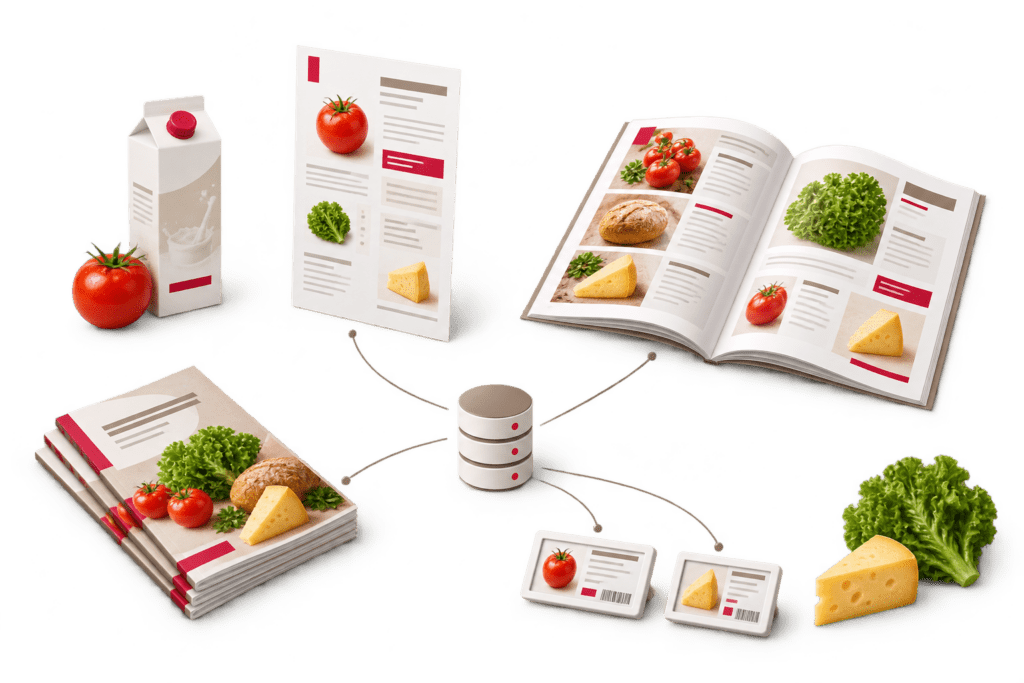
For many, retail automation still brings checkouts, warehousing, or logistics to mind. Yet one of the sector’s biggest — and most overlooked — challenges lies elsewhere: turning product data into promotional leaflets, catalogs, labels, point-of-sale materials, and digital publications. This is precisely where InBetween comes in. Its publishing automation software connects product data with templates, workflows, and Adobe InDesign, helping retailers automate the repetitive stages of publication production while retaining creative and regional flexibility.
The Reality of Grocery Retail: Complexity as a Constant
The grocery retail sector is structurally complex by design. Major retail groups such as EDEKA and REWE operate as cooperatives. Thousands of independent retailers manage their stores autonomously, with their own assortments, promotions, and regional leaflet editions.
Sources: EDEKA 2025 business figures, REWE Group, 2025 financial year, and German Retail Federation
This decentralized structure ensures local relevance and keeps retailers close to their customers. However, it also increases the publishing workload. Every region, independent retailer, and retail banner requires its own variations of prices, product information, promotional materials, and labels.
At the same time, omnichannel expectations continue to rise. Product data must remain consistent and up to date across promotional leaflets, shelf labels, online shops, apps, and delivery services. The shortage of skilled workers adds further pressure. Automated publishing processes reduce repetitive tasks and ease the workload for existing teams!
Why Traditional Processes Are Reaching Their Limits
In many grocery retail marketing and product data departments, promotional leaflets, catalogs, and labels are still produced through a chain of manual steps. Data is compiled from PIM and ERP systems and Excel spreadsheets, placed in InDesign by hand, emailed for approval, and adapted separately for each region. With hundreds of variants per issue and a weekly or biweekly publishing schedule, the work becomes a never-ending sprint.
The Typical Manual Process
- Compile data Gather information from PIM and ERP systems and Excel spreadsheets.
- Place content Insert product data and promotions manually in InDesign.
- Request approvals Coordinate drafts, feedback, and corrections by email.
- Adapt variants Edit every region, language, and issue separately.
- Repeat changes Send prices, promotions, and labeling updates through the process again.
The result is long production cycles, error-prone copy-and-paste work, and repeated rounds of coordination. Every price change, new promotional product, and additional labeling requirement passes through the same manual chain—multiplied by every region, output format, and language.
Checkout systems, warehouse logistics, and online shops have long since been digitized. Yet the production of many sales-critical publications still relies on disconnected, manual workflows. This break in the digital process creates a significant amount of avoidable work.
An Illustrative Example
Consider a full-line grocery retailer with several hundred independent store owners preparing its next promotional leaflet. Headquarters provides the nationwide master layout, regional teams add local offers, and individual retailers set their own priorities.
Multiple handoffs, repeated work
The marketing department sends out Word or Excel templates, collects feedback by email, reconciles prices and promotional items, and hands the content over to the design team. Each regional edition is then assembled separately in InDesign—with a corresponding number of potential errors and approval loops.
Centralized data, structured collaboration
Product information, prices, and promotional data come from the relevant systems of record, such as the PIM, ERP, or campaign planning system. Regional teams and independent retailers can add local content through web-based publishing and collaboration tools within defined roles and workflows. Approved content is placed in data-driven templates and used to generate the required editions. When source data changes, controlled updates can be applied to all affected variants without rebuilding each one manually.
This shifts the focus of the work away from compiling and checking information and toward assortment decisions, campaign planning, and brand management.
Systematic Automation — Not Automation for Its Own Sake
Automation in retail does not mean eliminating creativity or local customization. It removes repetitive steps from the value chain and creates more time for work that requires human experience and strategic decision-making.
InBetween’s approach is built on four components:
- Reliable data foundation InBetween connects PIM, ERP, and other data sources to the publishing process. During implementation, the authoritative source for each type of data is clearly defined.
- Automated production Promotional leaflets, catalogs, labels, and other data-driven documents can be generated from approved product data through automated or partially automated workflows, including direct integration with Adobe InDesign.
- Centralized collaboration Web-based planning, review, task assignment, status tracking, and approval points bring participants together in a coordinated publishing workflow.
- Local flexibility Regional teams and stores can make permitted adjustments within defined templates, roles, and workflow rules while headquarters retains control of brand standards and shared content.
Automation does not replace the diversity of grocery retail. It makes that diversity manageable.
An effective publishing automation approach combines centralized control with regional flexibility. Only this combination makes production scalable when large numbers of products, stakeholders, languages, and variants are involved.
Proof, Not Promises: What Automation Delivers in Practice
Real customer projects demonstrate the impact of data-driven publishing. A central data foundation supports up-to-date publications across regions, languages, formats, and output channels — automated, brand-compliant, and significantly faster.
The examples range from regional promotional leaflets and extensive product catalogs to multilingual point-of-sale materials.
Centralized Control, Regional Delivery
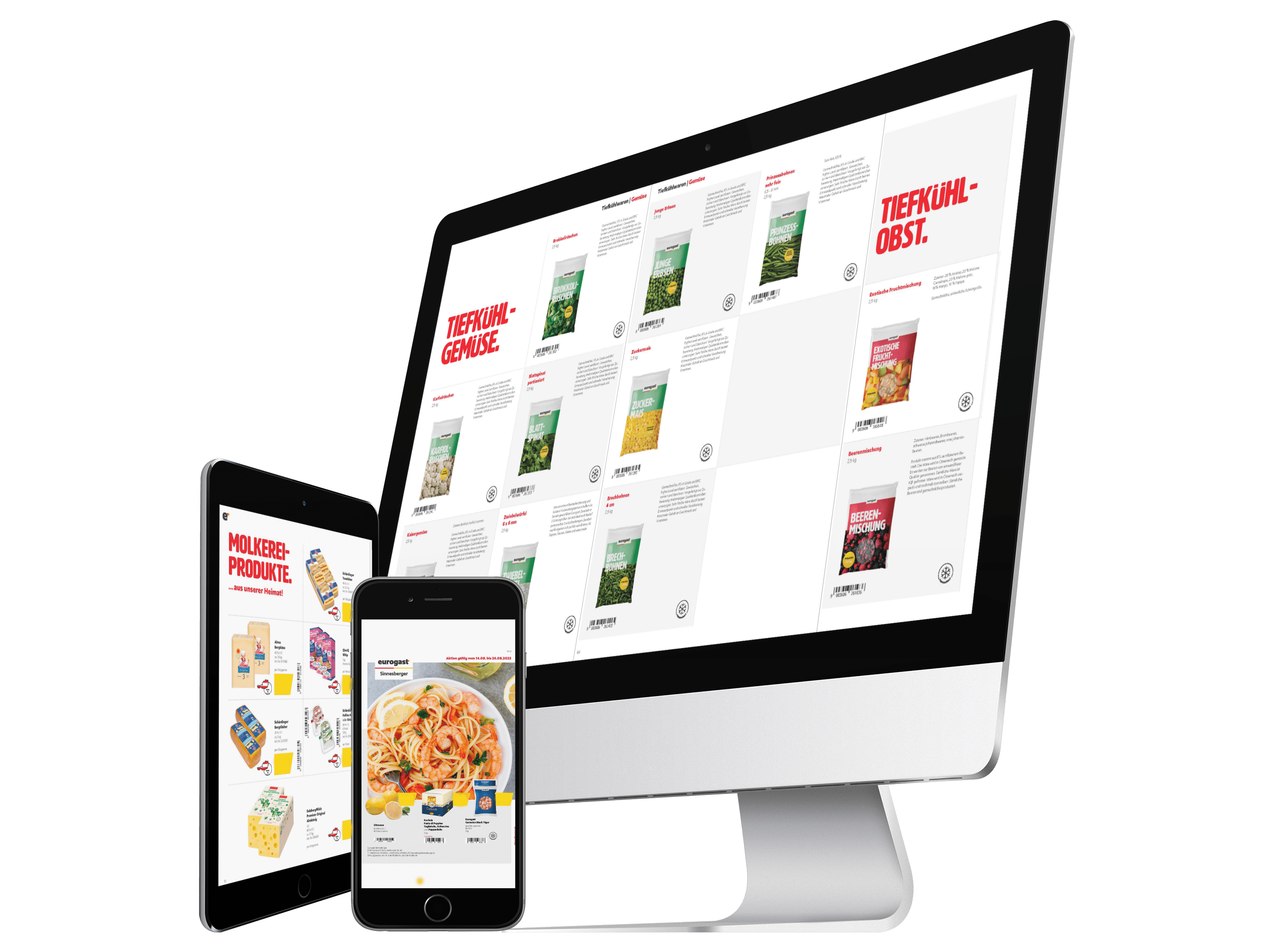
The Eurogast example demonstrates the impact of this approach. The Austrian B2B wholesaler for the hospitality industry manages product information for around 40,000 items. Every two weeks, one centrally created master publication is used to generate 14 regional leaflet editions for 19 locations — equivalent to roughly 350 regional editions per year.
The result:
Product data is maintained centrally and transferred automatically to the relevant publications, while regional teams can customize the content for their local assortments. This improves collaboration between central and regional teams and increases the efficiency of the publishing process.
From a Six-Month Project to an Up-to-Date Catalog
Other projects demonstrate similar benefits across different publication types. At pet care specialist Vitakraft, the time required to create an assortment catalog fell from approximately six months to just 14 days. Instead of publishing a new catalog every two years, the company can now release an up-to-date version every three months. The level of automation exceeds 80%.
Multilingual POS Materials Directly from the PIM
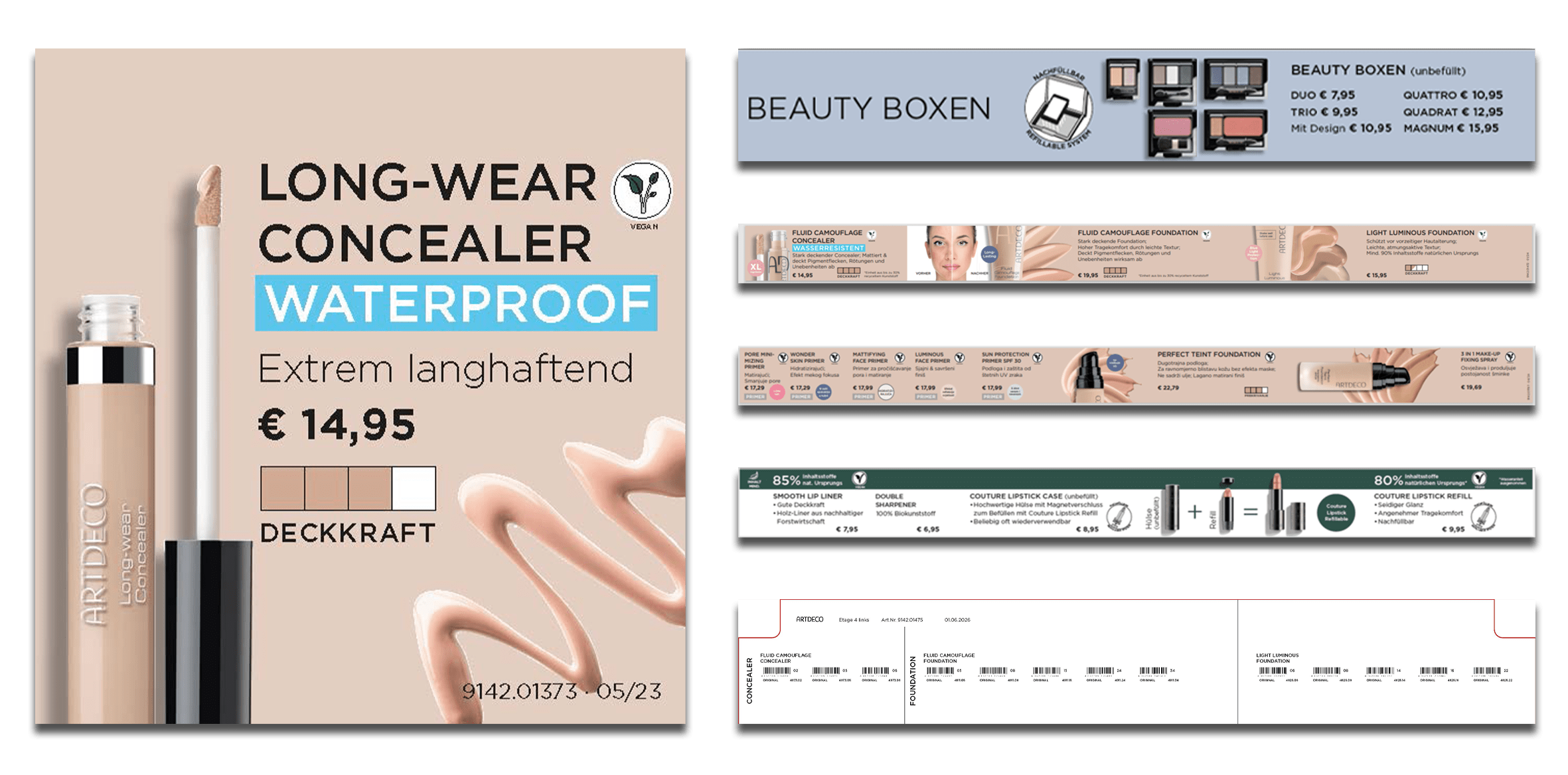
Cosmetics manufacturer ARTDECO uses InBetween to automate the production of point-of-sale inserts and EAN labels in twelve languages. Product information, prices, EANs, barcodes, icons, and localized content flow from the central Akeneo PIM system into dynamic InDesign templates. As a result, the creation of label inserts has been accelerated by 80%.
Understanding Grocery Retail Means Knowing Where Automation Makes a Difference
Publishing automation in retail is not a one-size-fits-all IT project. It works only when it takes into account cooperative structures, the diversity of retail banners and private labels, and the demanding publishing schedules of the grocery retail sector.
InBetween brings experience in database publishing for more than 30 years, along with projects involving numerous variants, many stakeholders, and tight deadlines. Its combination of data connectivity, automated document generation, Adobe InDesign integration, and web-based publication management makes complex publishing processes easier to control and scale.
Companies that treat promotional leaflets, labels, catalogs, point-of-sale materials, and other product communications as a connected, data-driven process can reduce production effort, accelerate updates, and improve consistency. At the same time, marketing teams gain more time for assortment decisions, campaign planning, brand management, and relevant customer communication.
FAQ
Frequently Asked Questions About Product Data and Publishing Automation
Answers about data-driven publishing, automated publications, e-commerce, marketplaces, and InBetween’s modular solutions.
What is data-driven publishing?
Data-driven publishing is the automated or partially automated creation of print and digital publications from structured information stored in connected source systems. Product data typically comes from PIM or ERP systems, while images and other digital assets may come from a DAM system. InBetween connects this approved content with templates and publishing workflows to create brand-compliant catalogs, promotional leaflets, price lists, labels, product datasheets, and other documents.
Can the same product data be used for e-commerce platforms and marketplaces?
Yes. Centrally managed product data can provide a shared foundation for print publications, online stores, e-commerce platforms, and marketplaces. InBetween reuses data from connected source systems for data-driven publication and document-generation workflows. Directly supplying a particular e-commerce platform or marketplace depends on the company’s system architecture, syndication solution, and available interfaces.
How can product information remain consistent across different channels?
Cross-channel consistency starts with clearly defined systems of record and ownership for each type of content. For example, product attributes may be maintained in a PIM system, prices in an ERP system, and images in a DAM system. InBetween retrieves approved content from these sources and reuses it across publications and output formats. This reduces duplicate data entry and helps prevent conflicting descriptions, prices, specifications, and images. Depending on the configured workflow, documents can be updated on demand or regenerated automatically on a schedule.
Can an up-to-date product datasheet be generated on demand?
Yes. The InBetween Datasheet Automation App generates brand-compliant PDF product datasheets directly from Akeneo PIM. It synchronizes the selected product data immediately before generation and saves the finished PDF back to Akeneo as a linked product asset that can be shared, downloaded, or distributed.
Datasheet Automation supports on-demand generation for individual products. Datasheet Automation Pro additionally supports scheduled bulk generation, such as nightly regeneration, and delta updates for multiple changed products.
What are the benefits of publishing automation for retail and grocery retail?
Publishing automation helps retailers manage large assortments, frequent price and product changes, short production cycles, and numerous regional or channel-specific variants. InBetween connects central product data with templates, collaborative publishing workflows, and document generation. This can reduce repetitive layout work, shorten update cycles, improve consistency, and make it easier to produce promotional leaflets, catalogs, labels, datasheets, and point-of-sale materials at scale.
Can InBetween create regional, multilingual, and customer-specific variants?
Yes. InBetween can assemble and generate publication variants by region, language, assortment, customer, audience, or output channel, provided that the required data, templates, and business rules are available. Central templates and design rules maintain brand consistency, while role-based workflows can allow local or customer-specific adjustments within defined limits.
How does InBetween support fully and partially automated publishing?
For fully automated workflows, InBetween can generate and update publications in the background once the required data connections, templates, and rules have been configured. For partially automated workflows, the InBetween Publication Wizard Pro helps teams assemble publications from connected product data and predefined master pages through a web-based interface. It supports direct input, annotations, reviews, and collaborative document assembly.
The InBetween Planner supports publication planning and management, including schedules, responsibilities, tasks, status tracking, workflows, and review processes. The InBetween InDesign Plugin connects dynamic product data with creative layout work in Adobe InDesign.
The appropriate level of automation depends on the publication type, data quality, approval requirements, production volume, and desired degree of creative flexibility.
Is the InBetween software modular and adaptable to business requirements?
Yes. The InBetween Software Suite is modular and supports full automation, partial automation, publication planning, collaboration, template creation, on-demand document generation, and Adobe InDesign integration. Companies can use the complete platform or select the modules required for a particular publishing process.
During implementation, data connections, templates, workflows, output formats, and the level of automation can be aligned with the organization’s requirements. This makes InBetween suitable for individual publishing teams as well as enterprise-wide production environments.
How does AI support product communication?
The InBetween AI Vision Studio analyzes product images and generates image descriptions, multilingual captions, alt text, metadata, and SEO-friendly image tags and keywords. Teams can review and edit every generated text before publication and then reuse the approved content across catalogs, datasheets, websites, online stores, and other digital or print channels.
AI Vision Studio complements existing PIM and DAM systems rather than replacing them. Product images and core product data remain managed in the existing system landscape, while the generated image-related content becomes available to connected publishing workflows.
How can structured product content improve visibility in AI-powered search?
Structured, accurate, and clearly written product content makes it easier for search engines and AI-powered discovery systems to understand products, attributes, relationships, and use cases. Consistent product facts, descriptive headings, useful answers, accessible alt text, relevant metadata, and schema markup that matches the visible page content can all support discoverability.
InBetween helps teams create and reuse consistent product communication across channels. Publishing automation alone, however, cannot guarantee rankings, inclusion, or citations in AI-generated answers. Visibility also depends on crawlability, indexability, content quality, internal linking, website authority, and the overall user experience.
Über InBetween
Als weltweit führender Anbieter von Digital Publishing Lösungen steht die InBetween Deutschland GmbH seit mehr als 20 Jahren für die Professionalisierung des Produkt- und Markenerlebnisses. Mit unserer Software erstellen Sie Kataloge, Sales Folder, Preislisten, Datenblätter und vieles mehr automatisiert und auf Basis aktuellster Produktdaten. So sparen Sie signifikant und messbar Zeit, Kosten und erhöhen die Qualität Ihrer Output Dokumente durch die Reduktion manueller Fehler. Voll- oder teilautomatisierte Publikationen, personalisiert für verschiedene Kundensegmente, in unterschiedlichen Ausgabeformaten und Sprachen sind möglich – alles im Layout, das zu Ihrem Unternehmen passt.